








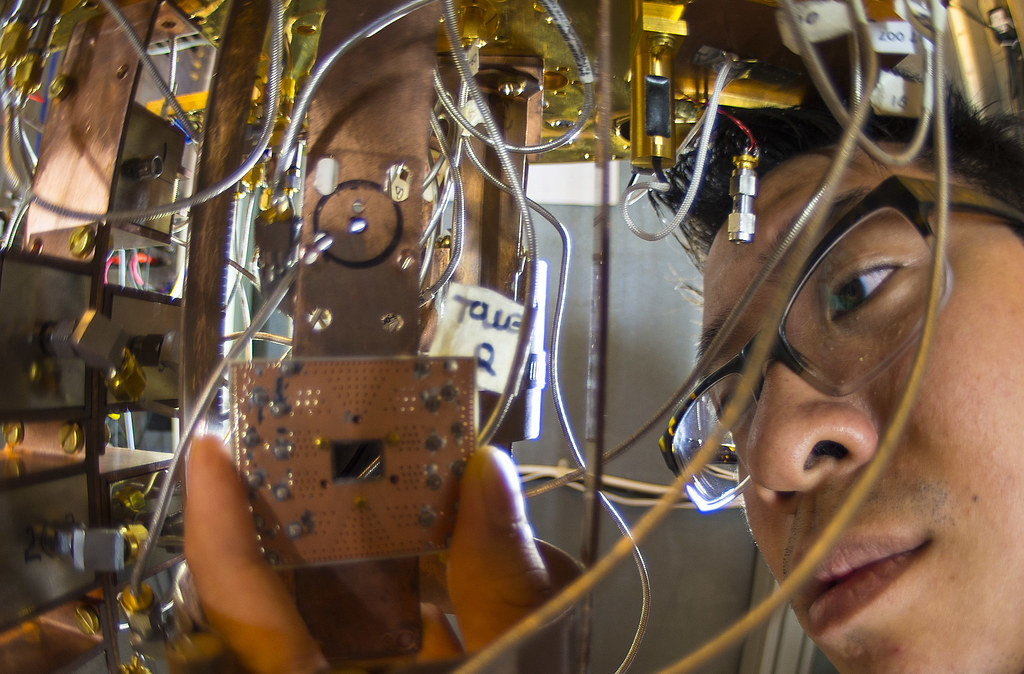
quantum computing is revolutionizing technology in ways many never expected. This weird phenomenon is pushing the boundaries of what we know about computation and physics.
What is Quantum Computing?
Quantum computing is a revolutionary technology that harnesses the principles of quantum mechanics to process information in ways that traditional computers cannot. Unlike classical computers, which use bits as the smallest unit of data, quantum computers use quantum bits or qubits. These qubits can exist in multiple states simultaneously, allowing quantum computers to perform complex calculations at incredible speeds.
The peculiar nature of quantum mechanics gives rise to phenomena such as superposition and entanglement. Superposition allows qubits to be in a state of 0, 1, or both at the same time, greatly increasing the computational power. Entanglement, on the other hand, enables qubits that are entangled to be correlated with one another, regardless of the distance separating them. This unique property can lead to faster information transfer and processing capabilities.
As researchers continue to explore the potential of quantum computing, numerous industries are beginning to take notice. Some of the most promising applications include:
- Cryptography: Enhancing security measures through quantum encryption.
- Pharmaceuticals: Accelerating drug discovery by simulating molecular interactions.
- Artificial Intelligence: Improving machine learning algorithms for faster data processing.
With its potential to solve problems beyond the reach of classical computing, quantum computing is proving to be a game-changer in technology.
The Weirdness of Quantum Mechanics
Quantum mechanics, the foundation of quantum computing, is often described as strange and counterintuitive. Unlike classical physics, where objects have definite states, quantum particles can exist in multiple states simultaneously, a phenomenon known as superposition.
This weirdness extends to how particles interact. Through a process called entanglement, two particles can become linked in such a way that the state of one instantly influences the state of the other, regardless of the distance between them. This challenges our traditional understanding of locality and causality.
The implications of these phenomena are profound for quantum computing. By harnessing superposition, quantum bits, or qubits, can perform numerous calculations at once, vastly increasing processing power compared to classical bits. This leads to the potential for solving complex problems, such as drug discovery and cryptography, at unprecedented speeds.
However, the paradoxes of quantum mechanics raise questions about reality itself. For instance, the famous Schrödinger’s cat thought experiment illustrates how a cat could be simultaneously alive and dead until observed, highlighting the peculiar nature of quantum states.
As researchers continue to explore the weirdness of quantum mechanics, the promise of quantum computing remains an exciting frontier, offering both challenges and revolutionary potential.
Applications of Quantum Computing
Quantum computing is set to revolutionize various fields by leveraging the principles of quantum mechanics. Its applications are diverse and impactful, showcasing its potential to solve complex problems more efficiently than classical computing.
Some of the most promising applications of quantum computing include:
- Cryptography: Quantum computers can break traditional encryption methods, leading to the development of new quantum-resistant algorithms.
- Drug Discovery: By simulating molecular interactions at an unprecedented scale, quantum computing can significantly accelerate the discovery of new pharmaceuticals.
- Optimization Problems: Industries such as logistics and finance can benefit from quantum algorithms that optimize routes, schedules, and investment strategies more effectively than conventional methods.
- Artificial Intelligence: Quantum computing can enhance machine learning processes, making AI systems more efficient and capable of processing vast amounts of data.
- Climate Modeling: With the ability to analyze complex climate systems, quantum computing can improve predictions and help in understanding climate change.
As research and development in quantum computing progress, its real-world applications continue to expand, indicating a future where this technology plays a central role in solving some of humanity’s most pressing challenges.
Challenges in Quantum Development
Despite its promising potential, the development of quantum computing faces numerous challenges that researchers must overcome. These obstacles range from technical limitations to theoretical complexities, making the path to practical applications of this technology both intricate and demanding.
- Decoherence: One of the primary challenges in quantum computing is decoherence, where quantum states lose their information due to environmental interference. This phenomenon can significantly disrupt computations and hinder the reliability of quantum systems.
- Scalability: Building large-scale quantum computers is another major hurdle. Current quantum systems often consist of a limited number of qubits, and scaling these systems while maintaining coherence and error correction remains a complex task.
- Error Rates: Quantum bits, or qubits, are highly susceptible to errors. Developing robust error correction techniques is essential to ensure the integrity of computations carried out by quantum computers.
- Material Limitations: The materials used to create qubits also present challenges. Researchers are constantly seeking new materials that can support stable and reliable qubit operations at practical temperatures.
As scientists continue to navigate these challenges, the excitement surrounding quantum computing grows, fueling ongoing research and innovation in this revolutionary field.
The Future of Quantum Technology
The future of quantum technology holds immense promise and potential that could revolutionize various sectors. As advancements in quantum computing continue to progress, researchers are optimistic about overcoming existing challenges and unlocking new capabilities.
One area where quantum computing is expected to shine is in pharmaceuticals. By simulating complex molecular interactions at unprecedented speeds, quantum computers could accelerate drug discovery and lead to breakthroughs in treatments for diseases that have long eluded researchers.
Another promising application is in cryptography. Quantum computers possess the ability to factor large numbers and solve problems that are currently intractable for classical computers. This capability could lead to the development of new encryption methods that are far more secure than those available today, ensuring safer digital communications.
Furthermore, advancements in quantum computing are likely to impact artificial intelligence. By processing vast amounts of data more efficiently, quantum algorithms could enhance machine learning and improve decision-making in real-time applications.
Despite the challenges that remain, including error correction and hardware scalability, the future of quantum technology is bright. As scientists and engineers continue to innovate, the full potential of quantum computing may soon be realized, transforming industries and daily life in ways we have yet to imagine.
Why Quantum Computing Matters
Quantum computing matters because it has the potential to revolutionize industries and solve complex problems that are currently intractable for classical computers. As the field of quantum computing evolves, its implications extend far beyond mere theoretical concepts, influencing areas such as cryptography, drug discovery, and optimization problems.
One of the key reasons quantum computing is significant is its ability to process vast amounts of data simultaneously, thanks to the principles of superposition and entanglement. This allows quantum computers to perform calculations at unprecedented speeds, making them invaluable for tasks such as:
- Cryptography: Quantum computers could break traditional encryption methods, necessitating new security protocols.
- Material Science: They can model complex molecular structures, leading to breakthroughs in material development.
- Artificial Intelligence: Quantum algorithms could enhance machine learning processes, allowing for faster training and improved accuracy.
Furthermore, the pursuit of quantum computing fosters technological advancements and interdisciplinary collaboration, encouraging innovation across various sectors. As researchers delve deeper into quantum theory and its practical applications, the potential for transformative change becomes clearer. Understanding why quantum computing matters is essential for grasping the future of technology and its societal impact.
By IBM Research via Openverse
References
The New York Times · Quantum computing
You might also like
AI Cyberthreats Legislation: What’s the Best Approach? · Conquering the Past: Is It the Best Way to Find Comfort? · Marvel Rivals Patch Notes: Clear Insights on Latest Changes